Sofia exceeded my expectations on a recent long weekend trip there. The Bulgarian capital had all the components of a great Eastern European city – compelling history and Brutalist architecture interspersed with an inviting mix of cafes, bars and restaurants. Moreover the large and lively city centre was very walkable and, what is more, it was awash with impressive churches, an Ottoman-era mosque, and, to my surprise, many Roman ruins.
Indeed, as I heard during the free walking tour I usually take to quickly get my bearings in new places (this time with Free Sofia Tour – recommended), Sofia apparently boasts 6,000 years of history. This includes having long served as a key Roman stronghold between Rome and Constantinople, and later surviving 500-odd years of Ottoman occupation, echoes of which were particularly evident to me in the cuisine, with things like kebabs, soups and sweet baklava ubiquitous.

Patriarh Evtimiy Boulevard, Sofia | Nov 2026.
Bulgaria regained its independence in 1878 with the aid of Russia’s victory in the Russo-Turkish War, a monument to which is the Neo-Byzantine Alexander Nevski Cathedral. In a story similar to Bucharest, Sofia was then made the capital city and began to fill with grand Western European-style buildings. But post World War II, the city was remade in a harsher, more utilitarian manner according to the prevailing communist vision, complete with a large Lenin statue in the city centre. It was interesting to hear that opinions on the communist era are still quite split among older Bulgarians, and that this is reflected in the country’s recent political trajectory, which has oscillated between pro-Western and pro-Russian sentiments.
Knowing Russian, I also found it easy to get around Sofia thanks to the Bulgarian language’s use of the Cyrillic alphabet. Moreover, I was intrigued to learn that Cyrillic was created in the 9th century not by Russians but by Bulgarians – which my engaging walking tour guide deemed the nation’s greatest invention. In short, I could easily read all the signs, and many of the words were familiar. For example, Bulgarian for thank you is “blagodarya” whereas a Russian version of it is “blagodaryu”.
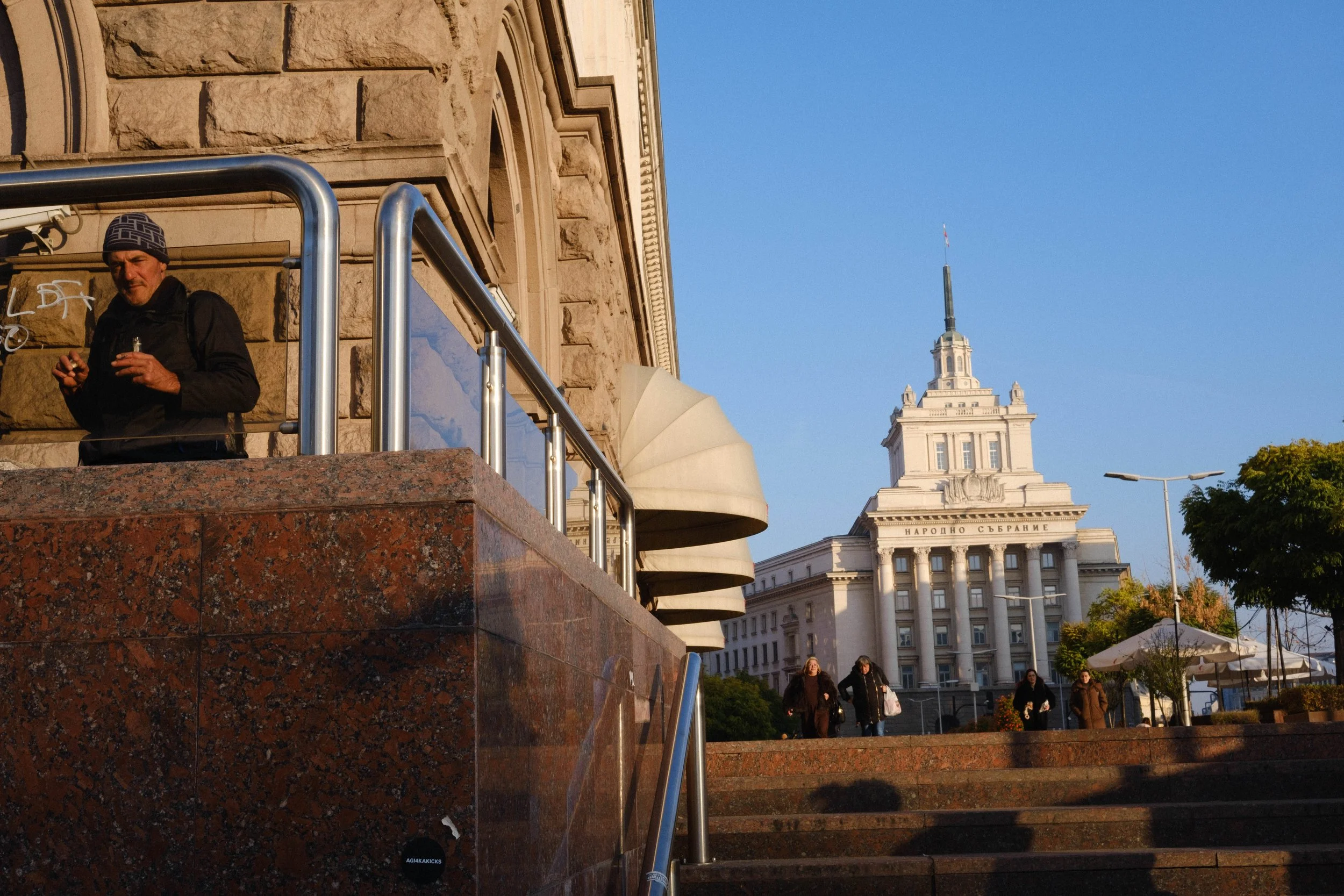
Serdika area, Sofia | Nov 2026.
Street notes
I was absorbed by this brush with Bulgarian history and culture, of which I knew little prior to my trip. However, I had come to Sofia to practise street photography, to add to my developing series exploring Eastern European cities. I’ve already visited Budapest, Warsaw, Chisinau and Bucharest. I think Sofia has been my favourite thus far, however. Why? Well, beyond all the above-mentioned and how easy it was to navigate, it felt relaxed and was replete with interesting structures, street art, light, and local atmosphere. I may not have taken fantastic photos, but I enjoyed being there and that is most important.
I focused my efforts on the city centre, encompassing the historic core – Serdika – where the Roman city was and where its recently unearthed ruins juxtapose strikingly with the Stalinist behemoths towering over them, now housing the Bulgarian parliament and Council of Ministers. Leading southwest from here, I enjoyed strolling along the popular, tree-lined Vitosha Boulevard and the buzzy network of streets in the adjoining Sredets district, which seemed to form the commercial city centre.
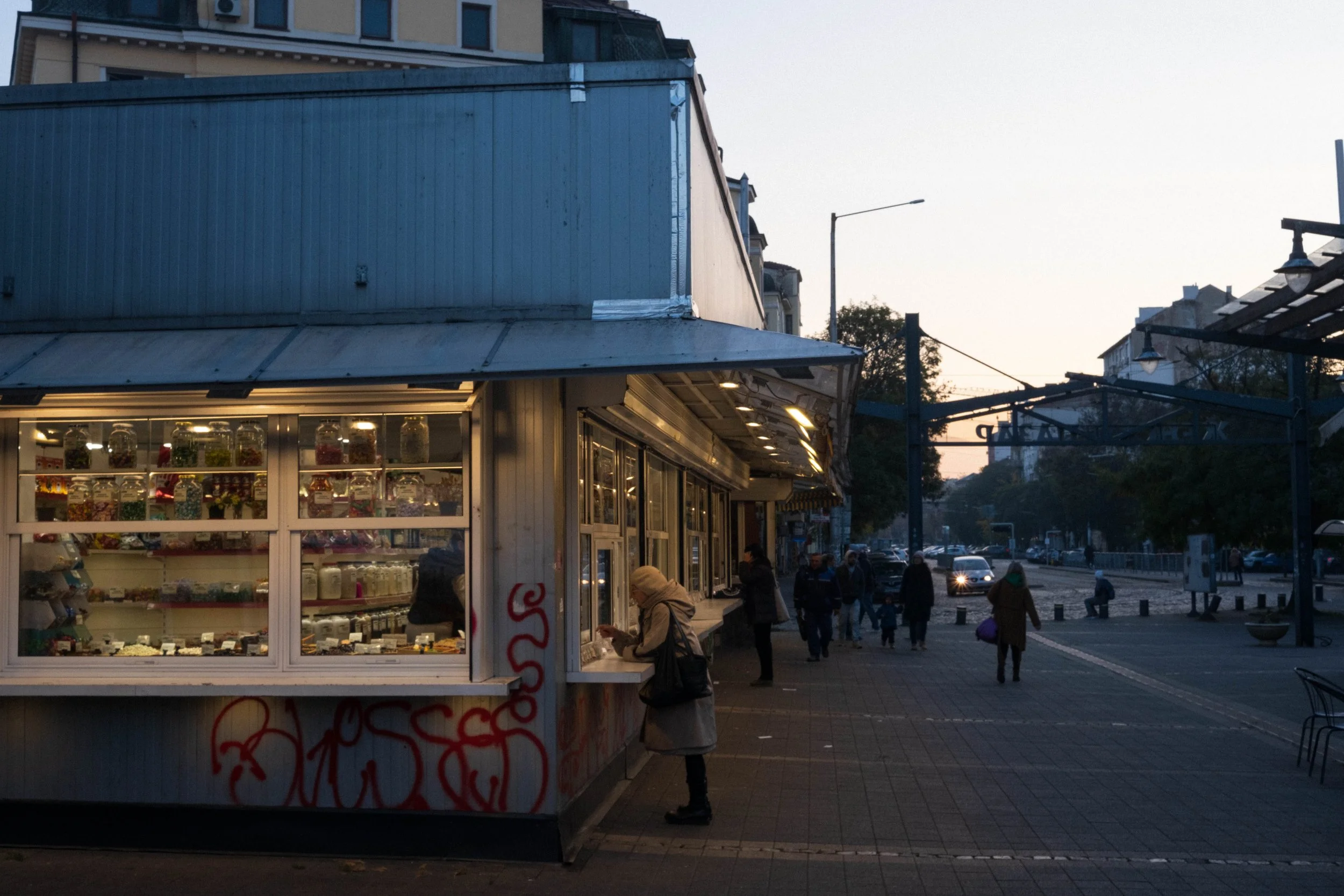
Women’s Market, Sofia | Nov 2026.
I found plenty here to photograph, especially as the weather was superb – pure autumn sunshine that was never too harsh and softened into a delightful glow as afternoon segued into evening. Besides Vitosha Boulevard, I found myself constantly pulled towards Graf Ignatiev Street, plied by boxy yellow trams and hosting book, clothes and jewellery shops, and numerous nice cafes and eateries. I walked up and down countless times, my photographic eye drawn particularly to patches of sunlight spotlighting people, posters, pillars and fragments of vibrant graffiti.
There were several other interesting streets connecting to Graf Ignatiev Street, such as Patriarh Evtimiy Boulevard, Tsar Shishman Street, and Knyaz Alexander I Street, which led to some leafy parks, such as Gradska Gradina (The City Garden). On the northern side of Serdika, I also perused the long Zhenski Pazar (Women’s Market), dating back to 1878, and its adjoining streets, which were more rundown but in a somewhat appealing way, given that much of the architecture predates the communist period. The area had an old world atmosphere, as well as an Oriental one, due to the number of Middle Eastern and Turkish cafes and restaurants. The market today sells food, spices, clothes, souvenirs and electronics.
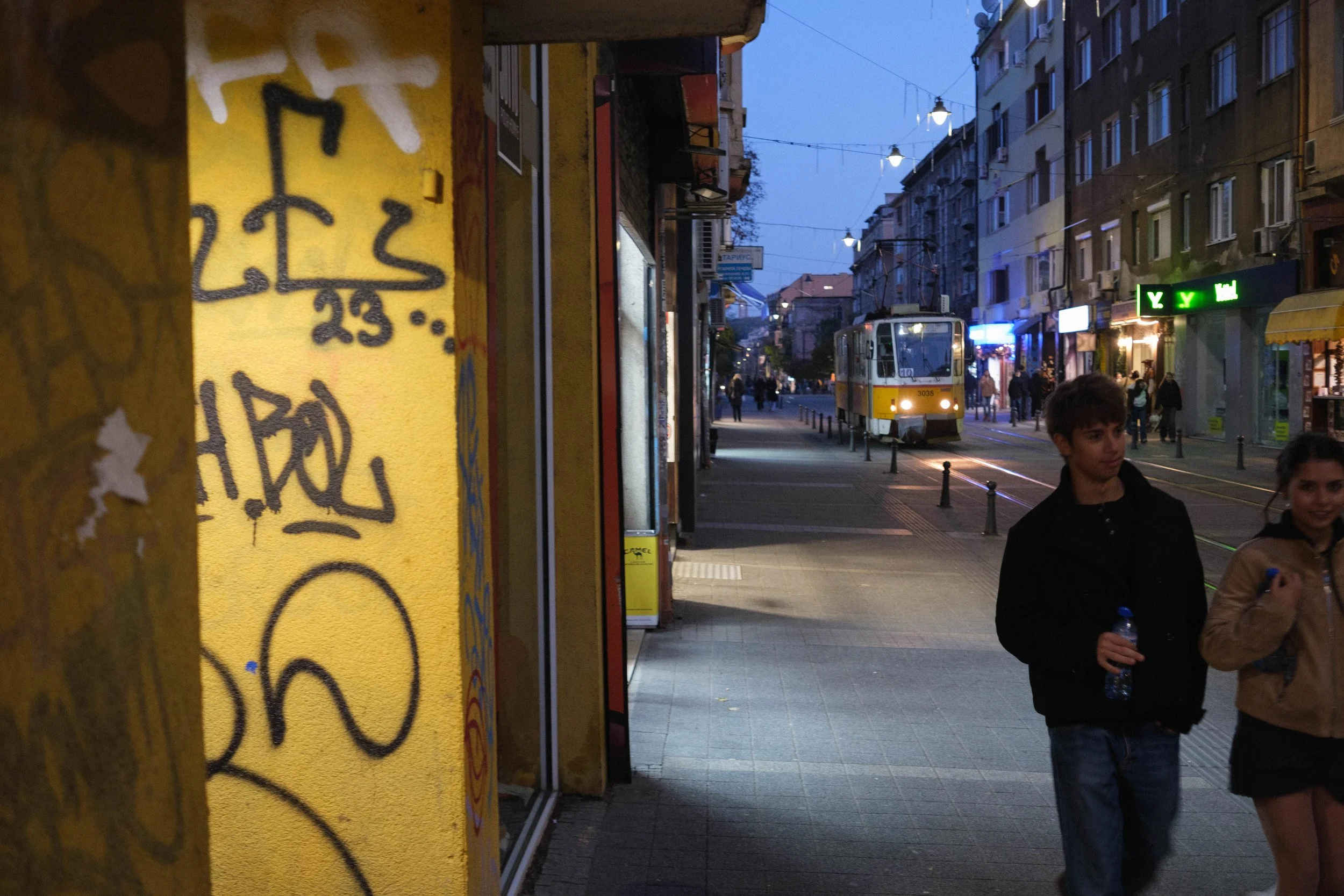
Graf Ignatiev Street, Sofia | Nov 2026.
Feeling that I should venture beyond the city centre, one afternoon I hopped on the easy-to-use Sofia Metro, which opened in 1998, and headed to the Hadzhi Dimitar district, because I’d read that it had housing blocks adorned with massive street art murals. Those were interesting, but I didn’t find much else, as the area was all residential, and I suspected much of the rest of Sofia was similar. So I returned to the city centre and remained there until it was time to head back to the airport via the metro, rounding off a fantastic few days in Bulgaria’s capital.