Street Photography in Budapest, Hungary
I had been to Budapest once before, briefly, around fifteen years ago, passing through on a rushed rail trip across Central and Eastern Europe. The visit was so fleeting that it left almost no impression — which, in itself, became the motivation to return. This time, I wanted to slow down and explore the Hungarian capital properly, through the lens of street photography.
It was pouring with rain on my first morning, so rather than heading straight out to shoot I opted to first get my bearings by joining a Free Budapest Walking Tour. This exceeded my expectations, offering a fascinating overview of Budapest’s (and Hungary’s) multi-layered and often turbulent history, narrated by a friendly and knowledgeable guide. That context - cultural, political, historical - proved invaluable over the following days, helping me to navigate and photograph the city with greater insight.
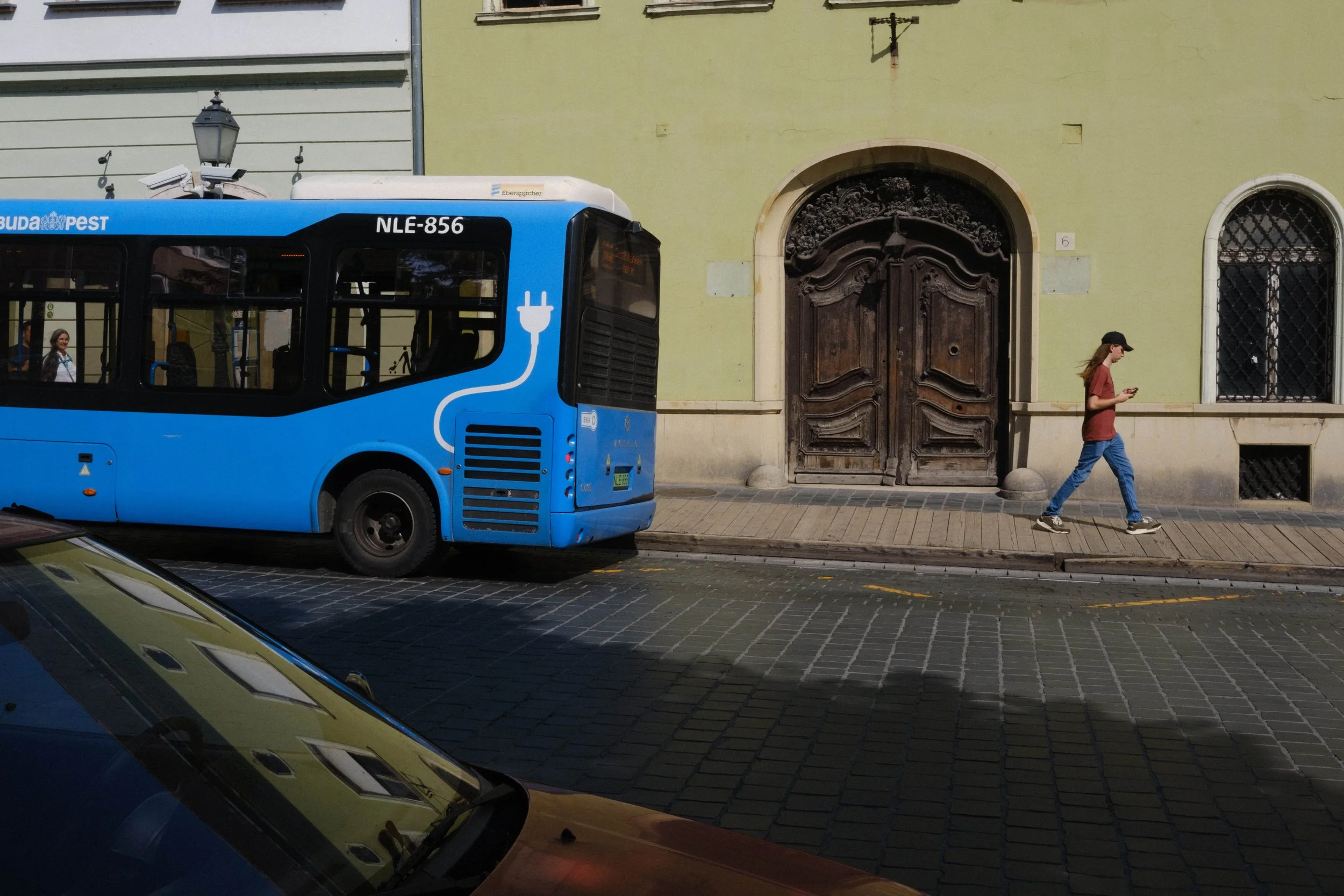
Buda district, Sep 2024.
Some history
I was intrigued to learn, for example, that the Hungarians don’t actually have European origins, having settled in this area of Central Europe in 896 from their ancestral homeland near the Ural Mountains. Thereafter, Hungary’s history evolved roughly as follows: the Hungarian Kingdom prospered until the early 16th century, when several centuries of foreign rule began, first under the Ottoman and then the Austro-Hungarian empires.
But a greater tragedy was to come after Hungary found itself on the losing side of World War I, in the form of the Treaty of Trianon (1920). This saw Hungary lose two-thirds of its historic territory, and over 3 million Hungarians stranded in new neighbouring states including Slovakia, Ukraine and Romania.
Hungary’s problems were then compounded by having allied with the Axis powers during World War II and again ending up on the losing side. Now it was occupied by the Soviet Red Army and a puppet Communist regime was established, headed by Stalin’s associate Matyas Rakosi. Communism lasted until 1990, albeit in a lighter form than elsewhere following the famous Hungarian Revolution of 1956. However, the freedom and democracy Hungary attained has been tested in recent years by a rise in illiberalism.
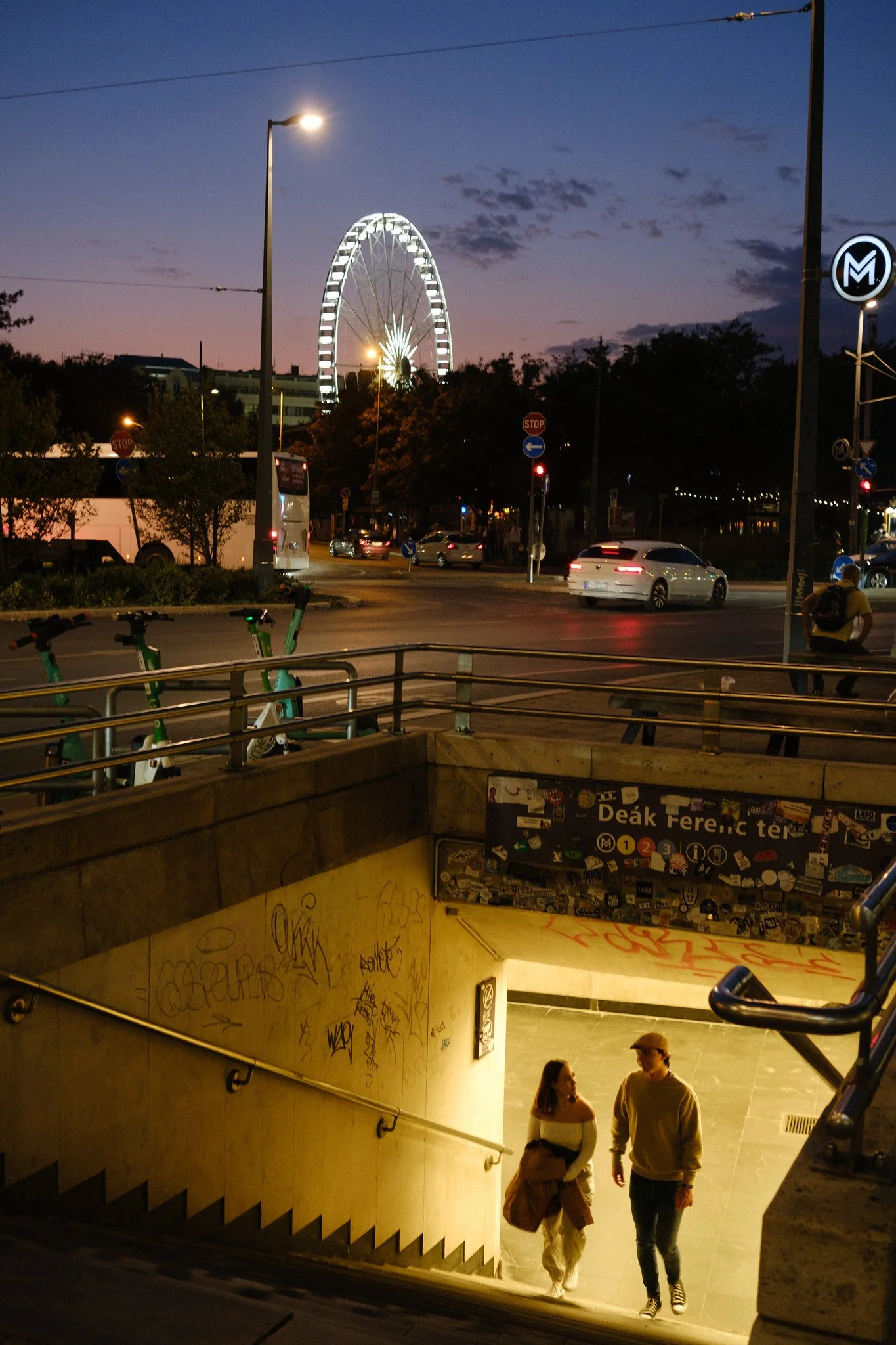
Deak Ferenc Square, Sep 2024.
Street photo hotspots
The tour led us through the city centre, from Deak Ferenc Square to the architecturally striking, Gothic Revival-style Hungarian Parliament. I was most impressed by all the grand, eye-catching architecture left over from the turn of the 20th century, built during the Austro-Hungarian Empire. The other dominant feature was the broad Danube river, which separates the city’s two main parts, Buda and Pest, and during my week in Budapest was flooded – a rare event that conjured large crowds and some unique photo opportunities.
Overall, I thought the long Danube riverside area was one of the best places for street photography in Budapest, especially around the bridge entrances and down by the Hungarian Parliament building, because the light was good here and people were always passing.
Other areas I particularly enjoyed included the city centre in general, with highlights including Deak Ferenc Square, Vaci Street (a long shopping street) and Fovam Square, opposite which stands the massive Nagycsarnok Market, dating from the late 19th century and hosting a multitude of local food and souvenir stalls. All of these areas were hubs of activity and alive with potential for street photos.
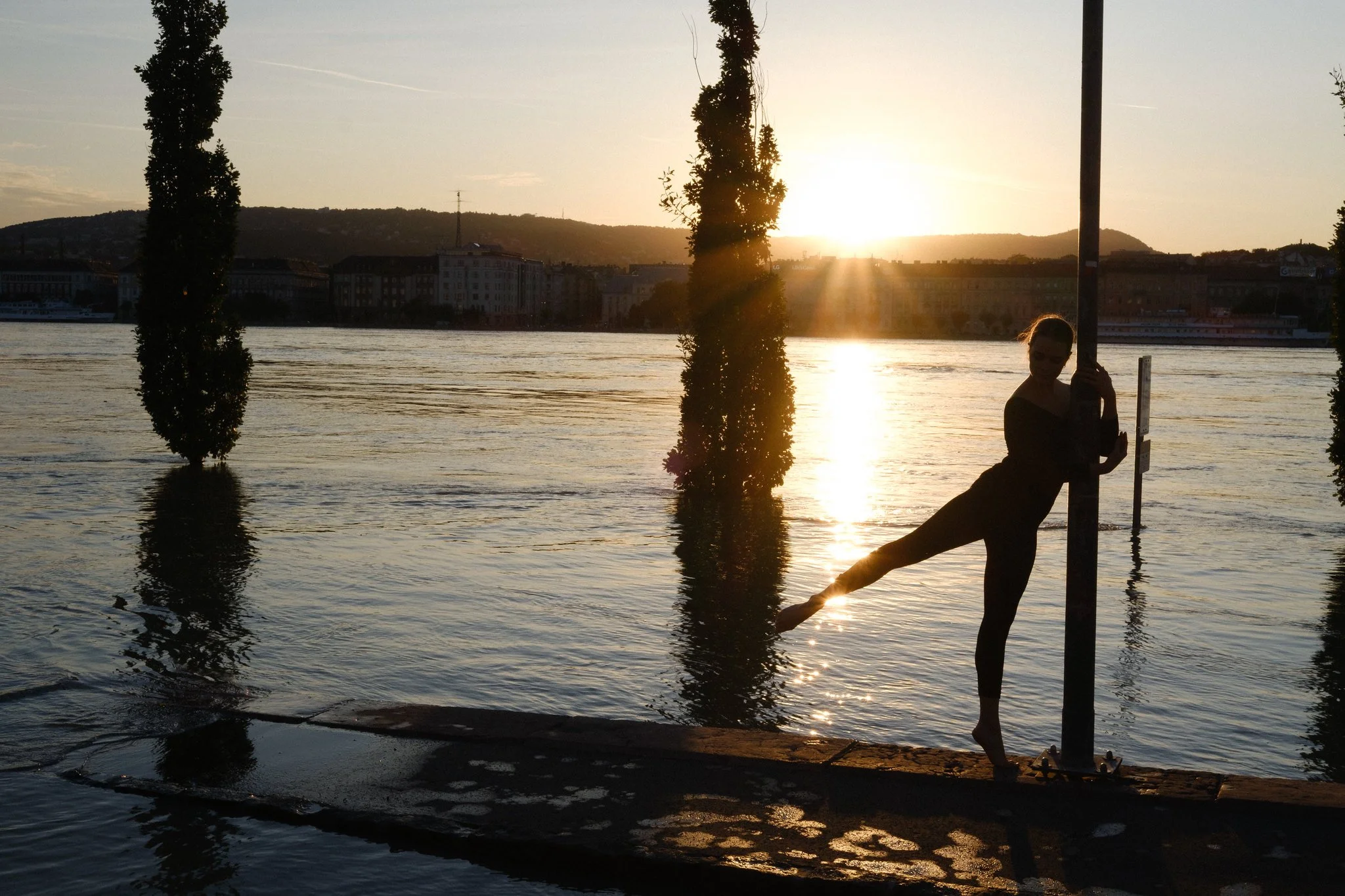
Ballerina by the Danube, Sep 2024.
Also worth wandering around, I think, are the historic Jewish neighbourhood north of Karoly Street and between Kiraly and Rakoczi Streets, which the Nazis turned into a ghetto during WWII. From there many thousands of Jews were deported to death camps, or even simply led down to the Danube river bank to be shot – a brutal episode in Budapest’s history, of which the Shoes on the Danube Bank monument is a poignant reminder. Nowadays the Jewish area is a hub of nightlife with many lively pubs, bars and restaurants interspersed with historic synagogues, elegant mansions and eye-catching street art.
Elsewhere, I enjoyed strolling along Andrassy Avenue, a very long and grand boulevard connecting the city centre and Heroes’ Square on the outskirts. The street is a UNESCO World Heritage Site lined with many of Budapest’s most sumptuous late 19th century buildings and hosting some of the city’s best cafes, theatres, museums (eg. the House of Terror) and embassy residencies. Moreover, beneath it runs the M1 metro line, which is apparently the second-oldest (or first continental) metro system in the world.
Buda Castle overlooking the Danube on the Buda side (Budapest is formed of Buda and Pest, formerly two distinct towns), and the surrounding district, is another popular photography spot, though a bit touristy for my liking.

Nyugati train station, Sep 2024.
Trips beyond Budapest
Having fully explored these areas and with a few days to spare, I then decided to take a couple of day trips to get a feel for Hungary more broadly.
First I took a train north from Nyugati Station to the slow-paced, attractive town of Esztergom, situated beside the Danube on the border with Slovakia. I had a few hours there of aimless wandering, including visiting the Esztergom Basilica, the largest church in Hungary and the town’s lone famous attraction. But it was under restoration, so I just enjoyed the views from its hilltop setting over the Danube towards Slovakia.
For my final day, I headed in the other direction from Budapest, first hopping on a bus to Memento Park, an open-air museum of Communist-era statues, before boarding a train that sliced through the flat countryside southwest to the ‘Hungarian Sea’ – Lake Balaton. Many towns and villages line this seemingly limitless lake, however the one I went to was Balatonfured, which on a Saturday afternoon was very peaceful and picturesque. Although I found it too lethargic and uneventful for street photography, the flatness of the lake being a rather featureless background.

Nightlife in the historic Jewish neighbourhood, Sep 2024.
Final impressions
And so my street photography adventures in Budapest came to an end. Over the course of the week, I found it to be a surprisingly rewarding and relaxed place to photograph – a city where daily life played out against a backdrop of grand history reflected in monumental architecture. Besides walking countless kilometres in search of compelling moments, I also gained a good sense of Hungary’s complex past and how it continues to shape the present. Moreover, I left eager to explore more of Central and Eastern Europe, both as a traveller and a street photographer.
Lastly, a caveat: Photographing people without permission is reportedly against the law in Hungary, although the law in this area seems to be inconsistently interpreted and applied. While plenty of great street photography has been done there, I have nevertheless chosen to be cautious and only show images where people are not easily identifiable. It is of course always a good idea to research street photography laws for wherever you go, as they do vary.
This post was first written in October 2024 and updated in December 2025.